API Response Monitoring: Why 'Up' Isn't Always Enough for Your SaaS
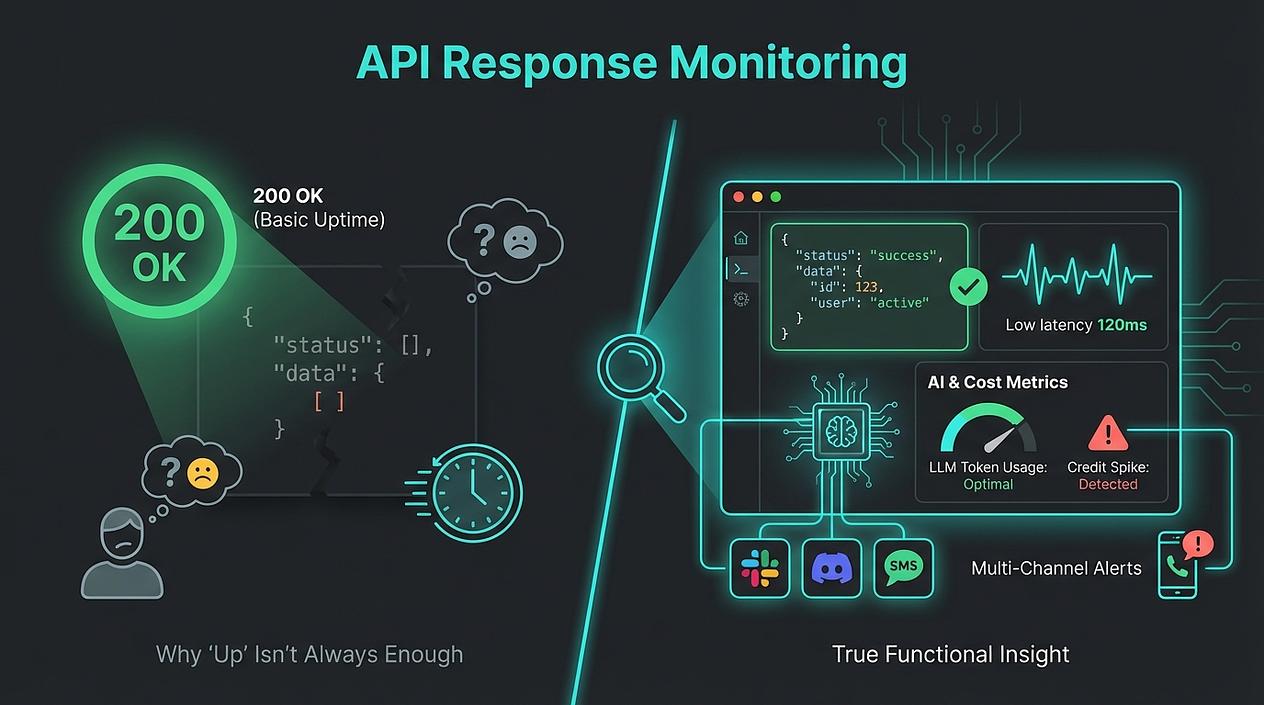
For most indie developers, the first sign of a broken API isn't a dashboard alert—it’s an angry email from a user or a sudden drop in conversion rates. We often rely on simple uptime checks that tell us the server is reachable, but 'reachable' doesn't mean 'functional.' A 200 OK status can easily hide a blank JSON body, a 500-millisecond delay that feels like an eternity to a mobile user, or a schema change that broke your frontend.
What is API Response Monitoring?
API response monitoring goes beyond the basic ping. It’s the process of programmatically validating that your endpoints are returning exactly what they should, when they should. According to Gravitee.io, this involves tracking metrics like response time, error rates, and resource usage to ensure service level agreements (SLAs) are met.
Instead of just checking if the front door is open, you’re checking if the lights are on and the furniture is where it belongs. It validates the payload, the headers, and the performance footprint of every critical request.
Why it Matters for Indie Makers
When you’re a solo founder or part of a small team, you don't have a dedicated SRE (Site Reliability Engineering) team to watch Grafana boards all day. You are the developer, the support agent, and the infrastructure lead.
- Silent Failures are the Deadliest: Your database might be up, but if your API returns an empty array instead of user data, your app is effectively down. Proactive monitoring catches these logic errors before they reach production users Uptime.com.
- The Performance Tax: Slow APIs kill user retention. Monitoring helps you identify bottlenecks—like a slow third-party integration—before they compound into a site-wide slowdown.
- LLM Cost Volatility: For modern SaaS apps built on AI, an API response isn't just data; it's money. Unexpected spikes in LLM usage or token costs can drain a startup's runway in hours without proper observability Sentinelboard.
How Sentinelboard Simplifies the Stack
We built Sentinelboard because we were tired of the 'observability tax'—the hours spent configuring Prometheus, exporters, and complex alerting rules. We believe monitoring should be as simple as the code it watches.
Zero-Configuration Monitoring You shouldn't need a PhD in DevOps to know if your API is working. Our platform offers a 'dead simple' setup with no agents to install. You provide the endpoint, and we handle the rest, checking your API 24/7 from multiple locations Sentinelboard.
Alerts Where You Actually Live Context switching is a productivity killer. Instead of checking another dashboard, Sentinelboard sends alerts directly to the tools you already use: Slack, Telegram, Discord, SMS, or custom webhooks. If a response fails or latency spikes, you’ll know within seconds Sentinelboard.
Built for the AI Era Unique to our platform is built-in LLM observability. We don’t just monitor your uptime; we monitor your OpenRouter credits and LLM token usage. Using OpenTelemetry-based tracing, we help you detect anomalies in AI costs before you get a surprise bill at the end of the month Sentinelboard.
Pay-As-You-Grow Pricing Indie makers shouldn't be punished for starting small. We offer a free tier with no credit card required, and our 'pay as you use' model ensures your monitoring costs scale linearly with your success, not ahead of it.
Monitoring isn't about building a wall of monitors; it's about buying back your peace of mind so you can focus on building features that matter.